Remember when there were no immunization shots and folks prevented disease with whole foods and exercise? Me neither. There has never been a moment in our lives when that statement was totally true.
Yesterday, we touched on colds. Today, we’ll take a look at some of the more serious diseases out there. This post will take a deep dive into the world of vaccinations and their necessity. At our close, you can decide if you should sprint over to CVS to get poked.
I was prepared to write a tongue in cheek post on this topic and sent a few photos over to Kaplifestyle’s editor extraordinaire, Stephanie. Apparently, she didn’t think riffing carelessly about the topic was responsible. She hit me back with a note:
Wading into a minefield, huh?
Translation: “What are you, an imbecile? You don’t want to mess around with a topic folks feel so passionately about. “ Plus, and I should have known this would be the case, Steph knows a thing or two about the topic.
Slightly more accurate translation: I’m okay with diving into controversial topics, but I think it should be done knowingly. More importantly, I think whenever there’s a topic that has potential life-threatening implications, we should treat it seriously.
Flu shots, shingles, mumps, measles, whatever. Are we protecting ourselves or causing harm? The Mayo Clinic weighs in:
“Vaccines for adults are recommended based on your age, prior vaccinations, health, lifestyle, occupation and where you travel.
The schedule is updated every year, and changes range from the addition of a new vaccine to tweaks of current recommendations. To determine exactly which vaccines you need now and which vaccines are coming up, check the Centers for Disease Control and Prevention’s website.”
I must be living in the dark because I’m not on any vaccine schedule and I’ll be 40 in July.
Luckily for you, that vaccine schedule isn’t quite as intense as it sounds. The CDC recommends, for a 40 year old male, a flu vaccine once per year, a tetanus/diphtheria/pertussis (whooping cough) vaccine or tetanus booster once every 10 years, a measles/mumps/rubella vaccine (once, if you weren’t vaccinated as a child), and possibly a vaccine for varicella (shingles), if you’ve never had chicken pox.
If you took all of them, that’s 2- 4 vaccines right now, then one per year after.
I think, in order to properly evaluate vaccines, we should first do a quick overview.
We often speak of the immune system on Kaplifestyle, discussing ways to boost the body’s natural defenses. It’s beyond clear that eating healthy, whole foods will promote a more robust immune system and enhance your ability to fight off diseases and illnesses.
I thought we’d never get here, Steph. This was my intended plan all along. We can help folks lean on natural….wait a second, I feel a “but” coming.
However (see, not a “but”), the body relies on being able to successfully identify pathogens in order to spur the immune system to deal with them. To put it (possibly overly) simply, if your body doesn’t know what it’s fighting, it can’t bring effective weapons quickly enough, and you get sick. Vaccines, in essence, “teach” your body about what it may encounter. They’re the messenger telling the army how to prepare.
I understand the desire to live and eat clean, relying on natural sources heavily. That shouldn’t relieve us of our obligation to be informed consumers, researching and discovering how we can maximize our health and well-being. Sometimes, that involves taking a hard look at the science. Vaccines are some of the most heavily studied developments in modern medicine, in part because they are so critical to health across the globe. These vaccines aren’t doing anything “unnatural” to your body; they’re stimulating your own immune system.
Pushback time. The act of poking oneself with a sharp needle and injecting a manmade substance carrying a virus or bacteria is unequivocally unnatural. Proceed.
Let me be explicit here – vaccines work. Smallpox killed between 300-500 million people in the 20th century. It was a nasty disease. The last person to be infected naturally was in 1977, because vaccines wiped it out. Vaccines are the reason why we don’t hear about polio anymore, although due to low vaccination rates in some countries (Syria, for instance), it’s not completely eradicated.
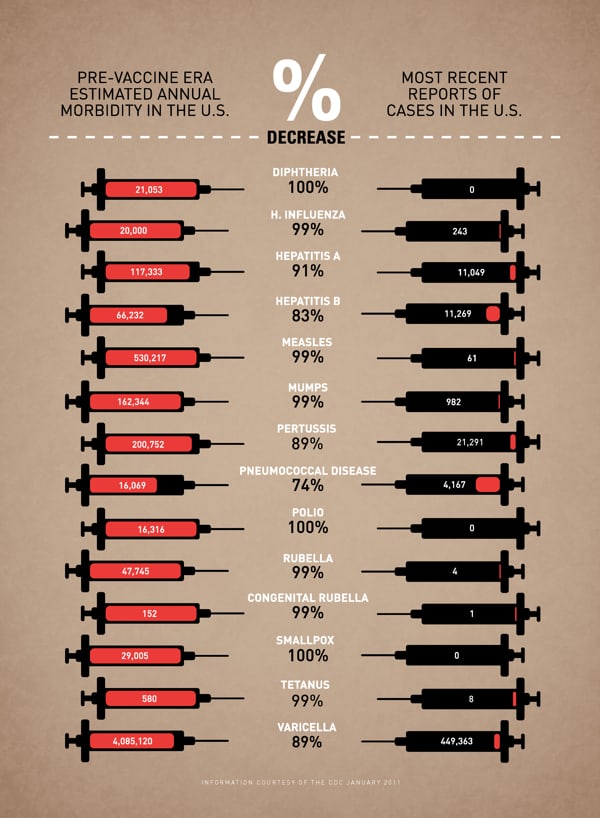
Now, it’s easy to understand how important the vaccines for smallpox and polio were. Those diseases are known for having high mortality rates and crippling impacts for the survivors. Measles and influenza don’t quite have the same deadly fear. They probably should. Measles kills .3% of the people it infects in the US, but can have a 25-30% fatality rate outside the US or for immunocompromised people. Influenza (the flu) kills millions, particularly children, the elderly, or other at-risk populations.
Of course, you’re not in those positions. Most folks reading this blog are healthy adults, with a strong immune system after eating berries, living with easy access to first rate medical care. You may be thinking to roll the dice, and if you do get the flu, it’s not such a big deal – a miserable few days and you’ll be back to normal. It’s not that simple.
Bigger picture injection (ooooh): Everyone should be obligated by law to build healthier immune systems. Widespread flu-shots may wipe out the flu but there will be another disease that follows. Immunizations may be huge, effective band-aids, but I wonder if they are another shortcut. I’m still listening.
By getting vaccinated, you protect other people, and particularly those people who are most vulnerable. Not everyone can be vaccinated – allergies, a compromised immune system, some people with cancer or organ transplant recipients, all of these may mean someone can’t receive standard immunizations. However, we don’t rely on every single individual being vaccinated to prevent the spread of disease. Most diseases have a threshold – the number of people who need to be vaccinated to prevent most transmission. If 85% of a population is inoculated against smallpox, it can’t survive in that population.
Just as we should be skeptical of marketing claims from mega-corporations, so too should we be skeptical of people claiming the “natural” and “holistic” position. Religious objections aside, the modern anti-vaccine movement was driven in large part by one individual, Andrew Wakefield. He claimed, in 1998, to have a study of 12 children who developed autism after receiving the MMR vaccine. Not only was he funded by people suing vaccine manufacturers (a clear, and undisclosed, conflict of interest), it later was discovered that he had falsified data and manipulated his results. He was stripped of his license for fraud.
Unfortunately, the impacts of his fraud have been huge. The US had actually come very close to eradicating measles, mumps, and whooping cough. Measles was thought to be entirely eradicated in 2000, in fact. However, due in large part to declining childhood vaccination rates, we’ve seen outbreaks of all three. This isn’t an abstract problem – the child whose parents decided not to vaccinate may not even get sick, but their classmate who just finished chemotherapy for leukemia may die. CBSNews:
So far this year, 159 cases of measles were reported in 16 states, with three outbreaks accounting for most of cases: outbreaks in New York City (58 cases), North Carolina (23 cases) and Texas (21 cases). That’s on track for the most cases since measles was considered eliminated.
Fortunately, said Schuchat, nobody has died.
Eighty-two percent of cases were in unvaccinated persons, and 9 percent were in people who weren’t sure if they’d been vaccinated. Seventy-nine percent of those the unvaccinated cited philosophical differences with the measles mumps and rubella (MMR) shot.
In 2012, at least 18 people died from whooping cough in the largest outbreak of the disease in the last 50 years.
This isn’t simply just a personal choice. This decision, in a very fundamental way, affects the lives of others.
We’ve got our work cut out, my friends. Y’all know that I don’t aim to make decisions for you. I always encourage freedom and flexibility of thought. Despite Stephanie’s breakdown, I’m not on my way to the doctor to get vaccinated. I am, however, ready to take a look at my previously uneducated paradigm and have an internal conversation.
Happy pondering,
Kap